
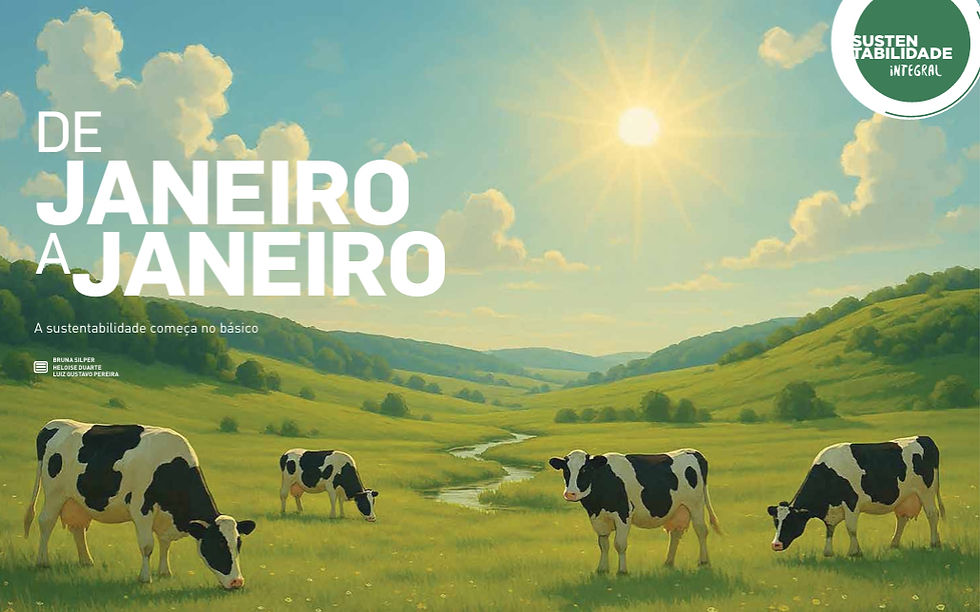
FROM JANUARY TO JANUARY: Sustainability starts with the basics.

This article was published in the "Integral Sustainability" column of Issue 202 of Leite Integral Magazine - click to access the complete issue.
January is a month of beginnings. The beginning of a cycle, of planning, of decisions that will shape the year. And it can also be a time to start over. Not with ruptures, but with reunions. Taking care of what truly sustains production: healthy cows, living soil, engaged people, data that makes sense. Before seeking outlandish solutions, everything begins with the basics, and it is there that sustainability is established.
Just like in the lyrics of the song "De Janeiro a Janeiro" by Roberta Campos, popularized by Nando Reis, which inspires the title of this column, "I will love you from January to January ," we are talking here about continuous dedication, without an expiration date. It is this type of commitment that sustains dairy farming: love for the craft, daily care for the animals, respect for the land, every day, in every season.
The countryside doesn't wait. It rains, it dries, it gets cold, it gets hot, and life goes on. The cows are milked, the pastures managed, the data recorded. In this context, sustainability cannot be a one-off project. Being sustainable is a continuous process, cultivated as a relationship: with presence, patience, and purpose.
Daily commitment to what is essential.
To speak of sustainability year-round is to acknowledge that there is no transition without perseverance. That no label, goal, or report can replace the careful management of the cow that remains in the herd for another lactation. The soil that is not left exposed between harvests. The technician who visits the property even on difficult days.
This is the kind of love that sustains. Not the kind that shines in big advertisements, but the kind that remains even when no one is watching. Because this is the kind that transforms into strategy when accompanied by data. Sustainability, at its core, begins with what is essential, and with what is done well, every day.
To speak of sustainability from January to January is to acknowledge that there is no transition without perseverance. That no seal, goal, or report can replace the careful management of the cow that remains in the herd for yet another lactation.
The US example
Between 1999 and 2024, the United States increased its milk production by approximately 39%, with only a 2.2% increase in the number of cows. This extraordinary productivity gain reduced enteric methane emissions by 26% per kg of milk produced, according to data presented by Martha Baker (Alltech) during Dairy Vision 2025. In a century, absolute emissions per kg of milk have fallen by more than 70% in the country, driven by genetics, nutrition, management, and reproductive efficiency, meeting population growth and increased demand.
However, as Baker pointed out, a significant portion of this progress was not measured with a focus on climate change, nor integrated into reporting mechanisms or the generation of carbon credits. The sector reduced emissions, but did not convert this progress into environmental recognition or valuation in the carbon market, missing opportunities that cannot be repeated.
What opportunities are there for Brazil?
Milk production in the country shows great diversity among farms. A portion already achieves productivity comparable to that of North American properties, but the majority still have low production per animal. This disparity exposes technical and structural inequalities, and at the same time, represents one of the greatest opportunities for mitigating emissions in the sector.
Reducing this production gap is simultaneously a strategy for economic efficiency and a concrete climate action. The more milk a cow produces within a well-managed system, the smaller the carbon footprint per kg of milk. But this is only feasible with management: measuring, planning, adjusting, and monitoring results consistently.
While the US demonstrates that it's possible to reduce methane emission intensity with productivity gains, Brazil has the opportunity to go further, connecting productivity and sustainability from the outset, with consistent measurement tools and reports that generate technical, environmental, and commercial value.
It is up to us to transform this opportunity into reality, starting with our daily lives: how we structure the herd, how we care for the soil, how we feed the animals, and how we connect information to management. The sustainability of livestock farming does not depend on future promises, but on solid practices, starting now.
Herd structure: an often overlooked environmental (and productive) asset.
Herd structure has a direct impact on the profitability, productive efficiency, and environmental sustainability of dairy farms. Despite often being overlooked, it is one of the areas with the greatest potential for practical improvement and objective measurement of progress.
Studies show that farms with higher rates of culling of lactating cows and a lower proportion of cows in production relative to the total herd tend to have higher greenhouse gas emissions. This occurs even when other areas of the farm, such as pastures and energy, show good indicators. In other words, sustainability starts with the basics: keeping good cows producing for longer.
The impacts of the reproductive structure of the herd were explored in depth in two studies presented at the 37th Annual Meeting of the SBTE (Brazilian Society of Embryo Technology) in 2024. The study by Abreu et al . showed that herds with low reproductive efficiency, defined by reduced pregnancy rates, long calving intervals, and high culling rates, have an unbalanced composition, with an excess of heifers and few cows in production. This increases fixed costs, decreases productivity per hectare, and raises emissions per kg of milk.
The work of Carvalho et al . demonstrated that cows with shorter calving intervals, i.e., more productive and with superior reproductive performance, contributed to a reduction in the carbon footprint per kg of milk. This is because they produce more milk throughout their lives, diluting the emissions associated with raising, managing, and feeding them. In other words, longevity is not just an economic advantage, it is an environmental strategy.
Data demonstrating these results were compiled and contextualized in the article " Reproductive Efficiency and Sustainability ," highlighting how strategic management decisions directly influence the environmental and economic indicators of milk production. The authors reinforce the importance of viewing the herd as a dynamic and strategic system. Improving the structure is not just a matter of management, but a decision that transforms three major pillars (Figure 1):
– Economical: fewer replacement heifers, lower rearing costs, higher return per animal.
– Environmental: fewer emissions per kg of milk, better use of land and inputs. – Social: more predictable routine, increased value placed on reproductive management and technical work.

Figure 1 - Impact of herd structure on milk production
When we connect this data to the emissions analysis tools available for the sector, we realize that herd structure is one of the variables that most influences the carbon footprint of milk. And most importantly: it is also one of the variables most accessible for improvement through planning, monitoring, and well-informed decisions.
Sustainability is achieved throughout the entire cycle: from reproductive planning to retaining good cows in the herd. This choice, made consistently, is what transforms technique into results, and efficiency into impact.
Balanced diet: right food, less impact
Animal nutrition plays a direct role in methane emissions and nitrogen excretion, two factors relevant to the environmental footprint of dairy farming. Adjustments to the herd's diet can improve feed digestibility, reduce losses, and transform nutritional management into a lever for sustainability.
Scientific studies compiled in the article " Impact of diet on greenhouse gas emissions and nitrogen excretion in livestock " reinforce the strategic role of nutrition in the sustainability of milk production. Diets with a higher proportion of concentrates and highly digestible forages, such as well-managed corn silage, can significantly reduce enteric methane production and nitrogen excretion in animal feces and urine, and also improve productivity.
Another relevant aspect is the strategic use of additives, protein sources, and waste management. Diet composition directly influences ruminal fermentation, feed retention time in the digestive tract, and the intensity of methane emissions. The scientific review presented in the eBook * Feed Additives for Methane Mitigation: Applied Science and Perspectives for Livestock* highlights that additives such as nitrates, tannins, and essential oils can interfere with specific metabolic pathways, reducing methane production without compromising animal performance. The eBook * Challenges and Solutions for Sustainable Livestock: Strategies for Reducing Methane Emissions in Milk Production* reinforces that these strategies must be adapted to the production system and associated with continuous technical and zootechnical monitoring to generate a real positive environmental impact.
In addition, a well-structured nutritional plan directly contributes to rumen health, improves pregnancy rates, and promotes the longevity of cows, strengthening the pillars of a truly sustainable system. Well-founded nutritional decisions reduce greenhouse gas emissions, optimize the use of inputs, alleviate pressure on the soil, and increase the economic efficiency of dairy production.
In summary, a cow's diet goes beyond productivity and cost: it is also an environmental management tool (figure 2).

Figure 2 - Diet impacts the sustainability of milk production.
Living soil: the invisible infrastructure of sustainability
The foundation of any sustainable production system begins where few eyes can see: in the soil. When the soil is alive, rich in organic matter, with high biodiversity and good vegetation cover, it acts as a true infrastructure of resilience. It absorbs and stores carbon, retains water more efficiently, supports deep roots, reduces losses due to erosion, and contributes to forage productivity without depending on excessive volumes of inputs.
Recent data compiled from various studies indicate that well-managed pastures with permanent vegetation cover generate positive chain effects: they favor nutrient cycling, reduce the need for chemical fertilization, improve water infiltration, and increase the availability of feed for livestock even during dry periods. An example is the article " Regenerative Livestock Farming: What Changes When Forest, Soil, and Carbon Enter the Center of Production?" , which gathers evidence on the potential of practices such as organic fertilization, pasture rotation, height management, and the use of bio-inputs to increase soil organic matter, a metric increasingly valued by carbon projects and ESG funds.
On the other hand, degraded soil compromises the entire chain. It requires more inputs, reduces the nutritional value of pastures, increases pressure on expansion areas and, above all, increases the farm's vulnerability to climate change. As the article Measuring Sustainability on the Dairy Farm points out , fragile and bare soils are directly associated with less efficient production cycles and a larger carbon footprint of the milk produced.
Adopting regenerative practices represents a shift in mindset: the soil ceases to be a neutral medium and becomes a key player in value creation. And this requires indicators. Monitoring how well-managed areas, together with an efficient herd structure, influence the sustainability of the farm is what allows for the generation of real evidence, and not just perceptions, about the impact of decisions in the field (Figure 3).
Investing in living soil is investing in what you can't see, but which sustains everything you harvest. Sustainability, from January to January, begins in the ground, but doesn't end there.

Figure 3 - Living soil for sustainability
Data that transforms care into argument.
None of the improvements mentioned throughout this text will be realized if they are not measured, recorded, and organized. Tools that integrate information have gained traction precisely because they allow for the visualization of connections between diverse indicators, such as animal welfare, carbon footprint, productivity, reproductive efficiency, and land use.
When we cross-reference this information, we can understand which practices truly support good results, and which others need adjustment. Furthermore, the ability to create customized indicators, adapted to the reality of each property, strengthens data-driven decision-making. It also facilitates the quantification of the results of much work and dedication to something that is not always tangible, and which needs to be guided by concrete evidence, not assumptions.
True sustainability is born from what is possible.
True sustainability is born in the field. From everyday life. From diagnosis, from listening, from the choice to keep a cow productive for longer. It's in the pasture, in the field, in the notebook or on the cell phone, which has become a work tool. It is born from the trust between technician and producer. In short, it is where things really happen.
For 2026, the challenge may not be adding more goals, but rather sustaining what has already begun. As the song "De janeiro a janeiro " says , "the universe conspires in our favor." We have in our hands the opportunity of a new year to build sustainable farms, with dedication, persistence, confidence, and collaboration.
References
Abreu et al. (SBTE Technical Studies 2024) – Contrast of low and high reproductive performance on herd composition, productivity, and carbon footprint in dairy production system [2] Carvalho et al. (SBTE 2024 technical studies) – Effect of calving interval on productivity and carbon footprint in high-producing cows
Reproductive efficiency and sustainability (ESGpec BLOG)
Feed additives for methane mitigation: applied science and perspectives for livestock farming. (ESGpec eBook)
Challenges and solutions for sustainable livestock farming: Strategies for reducing methane emissions in milk production (ESGpec eBook)
Regenerative livestock farming: what changes when forests, soil, and carbon become central to production? (ESGpec BLOG)
Measuring sustainability on the dairy farm (ESGpec BLOG)
Authors
Bruna Silper - Veterinarian, specialist in precision livestock farming and sustainable solutions, PhD in Animal Science and dairy farmer in Minas Gerais, CEO of ESGpec.
Heloise Duarte - Veterinarian, specialist in Agroindustrial Management and beef producer in MG, COO of ESGpec.
Luiz Gustavo Pereira – Veterinarian, professor and researcher, PhD in Animal Science, specialist in nutrition and regenerative systems.
The "Integral Sustainability" column is a column published by ESGpec in Leite Integral magazine , which has established itself as a space for dialogue between science, innovation, and practice in the field. Each article invites reflection on the future of dairy farming and on how we can balance productivity, animal welfare, and environmental responsibility.
Check out all the columns published in the magazine:
1️⃣ The wind of change — a call to recognize that the time for sustainability has arrived and that agriculture needs to act now.
2️⃣ Modern times — practical and technological solutions to reduce methane emissions in livestock farming.
3️⃣ Beyond the horizon — a vision of how innovation and regeneration open new paths for the milk of the future.
4️⃣ Simple way — how each producer's choice can transform livestock farming, making ESG something accessible and real in the field.
5️⃣ Nothing is by chance — animal behavior and welfare: The science applied to sustainable dairy production.
6️⃣ COP30: Time doesn't stop — What is the role of livestock farming on a planet under pressure?
7️⃣ COP30: We'll need everyone — What the world's largest climate conference revealed for Brazilian milk and why the next decade demands data, transparency, and real implementation in the field.
8️⃣ FROM JANUARY TO JANUARY: Sustainability starts with the basics — This article shows how consistent decisions, from herd management to soil care, reduce emissions and increase efficiency in milk production.
🌿 This column is the result of a partnership between ESGpec and Revista Leite Integral , and reinforces our commitment to making sustainability a practical, measurable, and inspiring topic.


