
Animal welfare beyond comfort: how science is assessing the emotions of dairy cows.
- Equipe ESGpec

- May 14
- 5 min read
For a long time, discussing animal welfare in dairy farming meant discussing physical comfort, health, nutrition, and management. Clean water, adequate feed, shade, ventilation, disease prevention, and well-planned facilities remain fundamental pillars, but science has advanced to an even more complex question: ultimately, is it possible to understand how a cow feels?
More than identifying pain, discomfort, or stress, researchers have sought to understand the so-called emotional states of animals. The aim is not to humanize bovine behavior, but to recognize that well-being also involves positive and negative experiences, which, in turn, influence behavior, adaptation to the environment, and even productive performance.
This discussion gained new visibility with recent studies published in the Journal of Dairy Science , and also with the technical commentary promoted by Purdue University, which highlighted one of the main questions in modern animal welfare research: how to objectively measure emotions in cows?
The challenge of measuring emotions without relying on human interpretation.
Unlike companion animals such as dogs and cats, cattle tend to express more subtle behavioral signals. In nature, showing pain or fragility can represent vulnerability, and this evolutionary characteristic makes emotional reading more difficult.

Therefore, assessments based solely on visual observation can be limited. An apparently calm animal is not always, in fact, in a positive state of well-being.
According to Heather Neave, a researcher at Purdue University and assistant professor of animal science, this difficulty also directly affects the relationship between producers and their animals. As she points out, producers often associate their own well-being with the well-being of the herd: when the animals are well, the work also makes more sense.
The point is that "being well" needs to stop being just a subjective perception and start becoming something measurable.
The judgment bias test: the "glass half full" of cows.
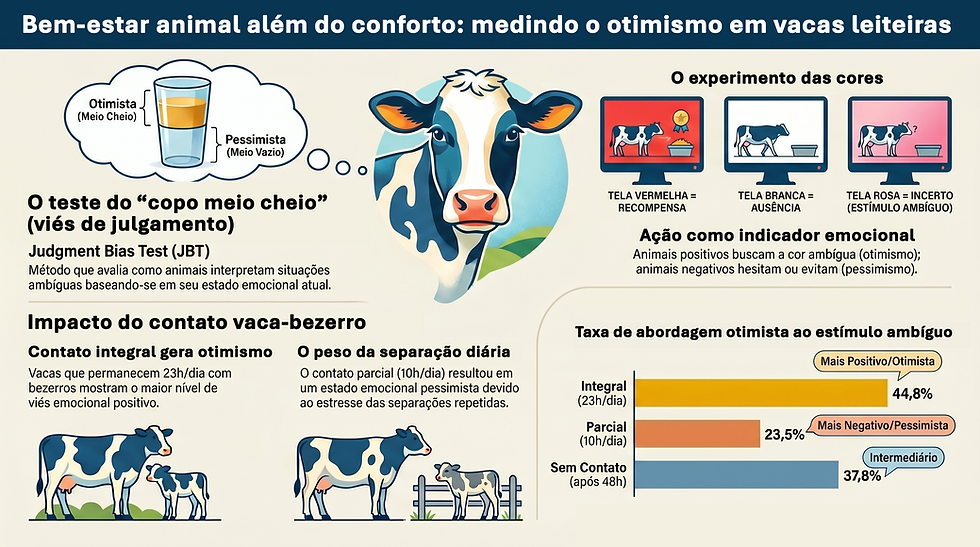
One of the most promising methodologies for this evaluation is the so-called Judgment Bias Test.
The concept comes from human psychology and is based on simple logic: individuals in more positive emotional states tend to interpret ambiguous situations more optimistically; individuals in more negative states tend to interpret these same situations with more caution.
It's the classic example of the glass being half full or half empty.
In studies with cows and calves, researchers adapted this logic to animal behavior.
The animals were trained to respond to visual stimuli presented on a screen:
A red screen indicated a reward.
A blank screen indicated an absence of reward.
Over time, the animals quickly learned to approach the color associated with the reward and avoid the other.
After that, the researchers presented a third situation: a pink, intermediate, and ambiguous screen.
The response to this stimulus revealed something important. Animals in a more positive emotional state tended to approach more quickly, taking the "risk" of seeking a possible reward. Animals in a more negative emotional state, on the other hand, showed greater hesitation or avoided approaching.
This behavior does not directly measure emotion, but it allows us to infer the emotional state from how the animal interprets uncertain situations.
According to the Feedstuffs technical publication, this approach was used precisely to investigate how handling experiences and routine procedures can influence the emotional perception of animals.
When repeated separation weighs more than separation itself.
One of the most interesting aspects of the study “Assessing the emotional states of dairy cows housed with or without their calves” was precisely a result that contradicted the most intuitive expectation about well-being. The researchers evaluated cows subjected to three different systems of contact with their calves, approximately 30 days after calving, using the Judgment Bias Test to identify the animals' emotional state.
The groups were organized as follows:
Full-time contact: cow and calf remained together for approximately 23 hours a day, with separation only during milking.
Partial contact (part-time): together for approximately 10 hours a day, with repeated separations between milkings.
No-contact: complete separation approximately 48 hours after birth.
Initial expectations might suggest that the group without contact would exhibit the worst emotional outcome. However, the study showed something different. The cows in the part-time system , with repeated daily separations, showed the most pessimistic bias of all.
The results of the approximation to the ambiguous stimulus showed:
Full contact: 44.8%
Contactless: 37.8%
Partial contact: 23.5%
In other words, the so-called "middle ground" was the most emotionally unfavorable scenario. The researchers' interpretation is that the problem lay not only in the absence of contact, but mainly in the unpredictability and stress of repeated separation. Early, single separation generated an intense initial response, but allowed for subsequent adaptation. Daily separation, on the other hand, created a continuous cycle of frustration and negative anticipation, favoring a more pessimistic emotional state. This result reinforces an important lesson for management: predictability matters.
In practice, inconsistent routines, abrupt changes, and repeated frustrating situations can be more harmful than one-off decisions, provided the subsequent environment offers stability. Animal welfare, therefore, depends not only on what happens, but also on how the animal learns to expect the environment to function properly.
Well-being is not merely the absence of suffering.
This is perhaps the most important point in this discussion.
For many years, animal welfare was primarily assessed by the absence of problems: absence of disease, absence of hunger, absence of pain, but current science is broadening this view.
An animal may not be sick and still live in an environment poor in stimuli, with an unpredictable routine, excessive social competition, or conditions that limit positive natural behaviors.
Well-being is not just about avoiding suffering; it's also about creating opportunities for positive experiences.
This understanding directly relates to modern assessment approaches, such as the five domains of animal welfare, which consider the animal's mental state as one of their pillars.
In the context of dairy farming, this includes aspects such as:
comfort during rest
management predictability
appropriate social interactions
mitigating stressful situations
an environment that encourages natural behaviors
This perspective is already appearing in technical materials applied to the sector. The BEA Score itself, used for structured assessment of animal welfare, considers internationally recognized criteria related to management, health, and comfort, allowing for a more objective and continuous diagnosis.
What does this change on the farm?
In practice, understanding emotional states doesn't mean turning the farm into a laboratory, but rather recognizing that seemingly simple decisions can profoundly influence the animal's experience.
Abrupt changes in herd size, overcrowding, failures in transition management, inconsistent milking routines, thermal discomfort, and aggressive handling are factors that affect not only production indicators but also how the animal responds to the environment.
When a cow begins to interpret the environment as unpredictable or threatening, this is reflected in its behavior, health, and efficiency.
On the other hand, stable environments, consistent management, and adequate infrastructure favor more positive responses.
Technology is also advancing in this direction. Sensors, behavioral monitoring, analysis of rest time, rumination, and activity patterns help reduce reliance solely on subjective observation.
The future of animal welfare will be increasingly data-driven.
The next step in sustainable livestock farming
Markets, consumers, and industries are no longer just looking for productivity. They demand evidence of accountability, traceability, and a commitment to sustainable practices.
In this scenario, animal welfare becomes, in addition to ethics and responsibility towards animals, also a strategic element of governance and competitiveness.
Measuring emotions may seem like a concept far removed from the reality of the farm, but in practice it represents an important evolution: moving away from guesswork and towards more accurate diagnoses.
Understanding whether a cow is emotionally well is not romanticizing production. It's science applied to livestock farming. It's a path to productive efficiency. And, increasingly, it will be an essential part of real sustainability within the farm gate.
Sources consulted
NEAVE, HW et al. Assessing the emotional states of dairy cows housed with or without their calves . Journal of Dairy Science, 2024.
Feedstuffs. Getting a read on farm animals' emotions . 2026.
Purdue University – What are animals feeling? Purdue animal scientists are learning how to read their emotions . 2026


