Technology and science focused on the social sustainability of dairy farms.
- Equipe ESGpec

- 4 days ago
- 9 min read
A new way to measure animal welfare using data from 326 Brazilian farms.
Every day, thousands of data points are collected from dairy farms around the world. Information on production, milk quality, management, health, and animal welfare feeds into software, spreadsheets, and management systems.
But only a small portion of this data meets three fundamental characteristics:
scale;
standardization;
sufficient methodological quality to answer scientific questions.
When this happens, they cease to be merely operational records and begin to generate evidence capable of guiding decisions, influencing public policies, and contributing to the advancement of science. This is exactly what happened with a study conducted by researcher Luiz Gustavo Ribeiro Pereira , from the University of Copenhagen , Denmark, in partnership with international researchers, using data from 326 Brazilian dairy farms evaluated through the ESGpec BEA Score methodology .
The results were presented during the ADSA (American Dairy Science Association) Annual Meeting 2026 , one of the most important scientific events in dairy science worldwide, which brought together researchers, universities, research centers, and companies from various countries to discuss the latest advances in the field.
This work demonstrates the methodological quality of the data produced in Brazil and the ability to transform information collected on farms into scientific knowledge with global reach, and, most importantly, it indicates the path for producers to improve animal welfare and the social sustainability of dairy farms.
In a scenario where much of the international research uses data produced in countries with temperate climates, seeing information collected on Brazilian farms contributing to the advancement of science also represents a recognition of the quality of research and dairy production developed in Brazil.
When animal welfare ceases to be just a concept.
In recent years, animal welfare has ceased to be treated merely as an ethical issue. Today it occupies a strategic position within the agendas of sustainability, food security, competitiveness, and access to international markets.
Within this broader perspective, animal welfare is directly connected to the social sustainability of production systems, as it reflects how the activity relates to animals, to the people involved in production, and to the expectations of society.
Consumers are increasingly demanding transparency. Large industries are incorporating welfare indicators into their supplier programs. International organizations have begun recommending standardized metrics. For example, the Dairy Sustainability Framework (DSF) , a benchmark for guiding the assessment of sustainability in the dairy sector, recommends Somatic Cell Count as an indicator of animal welfare.
At the same time, the challenge is growing of developing tools capable of objectively and scalably assessing animal welfare in a way that is applicable to the reality of commercial farms, and which can complement the basic CCS indicator currently used by companies linked to the DSF.
From individual assessment to data intelligence.
Assessing animal welfare is a complex activity. Unlike production indicators, welfare cannot be represented by a single variable. It depends on the interaction between several factors related to the environment, nutrition, health, behavior, and mental state of the animals. For this reason, the study used a multidimensional approach based on the five internationally recognized domains for assessing animal welfare.
From data collection to evidence generation.
Transforming data into scientific knowledge requires more than just a large volume of information. It demands method, consistency, and comparability. For data collected from different farms to generate reliable evidence, they need to be obtained through standardized protocols and organized in a way that allows for consistent comparisons between properties, teams, and regions.
In the present study, this process was structured in four stages: expansion of the evaluated property base, standardization of data collection protocols, digitization of evaluations using the ESGpec application, and generation of comparable indicators, which could later be used in the analyses conducted by the researchers. This methodological flow is summarized in Figure 1, which illustrates how data collected from dairy farms are transformed into standardized indicators and, subsequently, into results applied to the field.
Figure 1. "From farm to scientific evidence" framework: transforming data collected on dairy farms into scientific evidence capable of supporting research, management, and innovation.
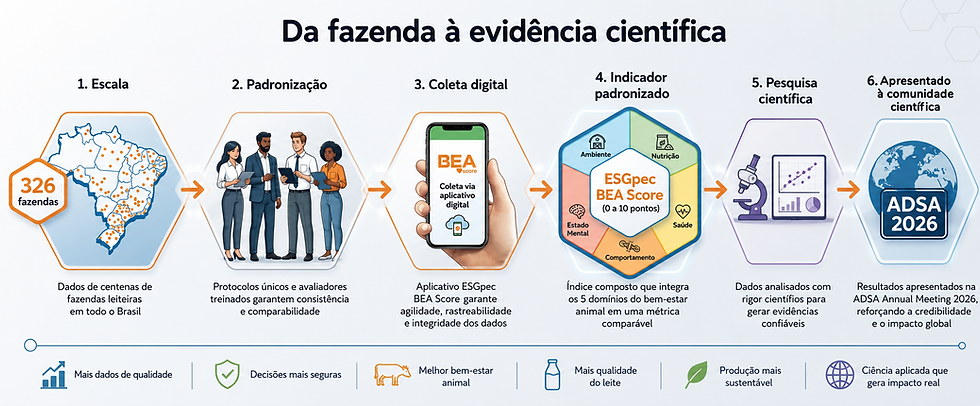
The combination of scale, standardization, and digitization makes possible something that has historically always been a challenge in animal welfare assessments: producing comparable indicators on a large scale while maintaining sufficient methodological consistency for scientific applications.
The study was coordinated by Luiz Gustavo Ribeiro Pereira, a professor at the University of Copenhagen affiliated with the Data and Modeling research group in the Department of Veterinary and Animal Science.
His career path connects two complementary fronts: the development of research in Europe, where the topic is at a more advanced stage of maturity, and the practical application of established methodologies to the reality of Brazilian dairy farming.
This integration between the university and the productive sector allows for the transformation of data collected in the field into scientific knowledge with the potential to impact different links in the production chain, and the final result is the fruit of the effort of a multidisciplinary team that involved producers, field technicians, dairy companies, the ESGpec team, and research professors from the University of Copenhagen.
The assessments were carried out by 26 evaluators trained by ESGpec, using the BEAscore digital application, i.e., the same data collection protocol used in 326 Brazilian dairy farms . Each farm received specific scores for the following domains:
Environment
Nutrition
Health
Behavior
Mental state
These results were integrated into a composite index, called the BEA Score , ranging from 0 to 10 points, allowing for a standardized comparison of the overall performance of the properties.
What the study investigated
The main objective was to verify the performance of Brazilian farms regarding animal welfare and to study the relationship between somatic cell count (SCC) and animal welfare score. To this end, the farms were grouped into four SCC categories:
less than 200,000 cells/mL;
between 200,000 and 300,000;
between 300,000 and 400,000;
greater than 400,000 cells/mL.
Spearman correlation analyses were used to assess the relationship between CCS and well-being scores, and Kruskal-Wallis tests and multiple comparisons with Holm correction, with a significance level of 95%, were employed to assess the differences in scores between the CCS groups.
Why is this study different?
Studies on animal welfare often face a significant challenge: transforming assessments conducted on different farms into truly comparable information. Differences in data collection protocols, assessor training, tools used, and sample sizes can hinder the interpretation of results and limit their large-scale application.
This study sought to overcome these limitations through a structured and standardized approach.
The unique aspect of this research lies in the combination of:
✔ 326 Brazilian dairy farms , representing a wide diversity of production systems;
✔ 26 trained assessors , using the same assessment protocol;
✔ Standardized digital data collection , ensuring traceability and integrity of information;
✔ Unique methodology , based on the ESGpec BEA Score;
✔ Statistical analyses , allowing for objective comparison of different CCS levels;
✔ Partnership between the private sector and academia ;
✔ Presentation at the ADSA Annual Meeting 2026 , one of the world's leading scientific events in dairy science.
 | ADSA Annual MeetingFounded in 1906, the American Dairy Science Association hosts one of the most traditional scientific gatherings dedicated to dairy science in the world. The event annually brings together researchers, universities, research centers, and companies to present studies in the areas of dairy production, nutrition, animal health, reproduction, genetics, milk quality, sustainability, and animal welfare. |
Having a paper selected for presentation at ADSA represents an important opportunity for scientific dissemination and discussion of results with the international community. For over a century, ADSA has established itself as one of the leading international forums for disseminating and discussing scientific advances related to the dairy industry. | |
 |  |
Luiz's presentation at ADSA | |
The results show a consistent pattern and great variability in the animal welfare score.
The BEA scores ranged from 40 to 90, with a mean and median of 72 and 73 for the 326 farms. 78 farms (24%) had scores above 80, 125 farms (38%) between 70 and 80, and 123 (38%) below 70. That is, ¼ of the farms already have scores above the 80 threshold, indicating a high probability of obtaining animal welfare certification, and 38% are close to achieving it. Meanwhile, 38% need structural work to improve animal welfare. Health and mental state were the domains with the lowest mean scores (66 and 70) and require more attention in animal welfare improvement programs.
The results revealed a clear association between increased SCC and reduced welfare indicators. In other words, the higher the Somatic Cell Count, the lower the farms' performance in animal welfare indicators. The association was observed in virtually all domains evaluated.
The Health domain showed the strongest correlation. Relevant associations were also observed in the Nutrition and Environment domains .
In addition to the correlations, the SCC groups showed differences among themselves, proving the relationship between SCC and well-being on dairy farms.
A result that draws attention .
Perhaps the most interesting finding lies in the evolution of the overall score. As the CCS increased, the BEA Score progressively decreased:
Figure 2. Progressive contraction of the multidimensional well-being profile as the Somatic Cell Count (SCC) increases.

Average animal welfare scores for the four SCC groups. A progressive reduction in scores is observed in all evaluated domains as SCC increases, resulting in a contraction of the multidimensional welfare profile. The BEA Score represents the overall score calculated from the integration of the five evaluated domains.
How to interpret the graph?
Radar charts allow for the simultaneous visualization of farm performance across different dimensions of animal welfare.
Each axis represents one of the components evaluated:
EMEN – Mental state
COMP – Behavior
AMBI – Environment
SAUD – Health
NUTRITION – Nutrition
The legend at the bottom of each graph shows the BEA Score , a composite indicator that integrates the results of the five domains and represents the overall performance of the property in animal welfare.
The larger the area filled by the graph, the better the performance in the different domains evaluated. The gradual reduction of this area among the groups highlights the contraction of the well-being profile as the Somatic Cell Count (SCC) increases.
The data behavior demonstrates a fairly consistent gradient. It is not simply a matter of properties with or without mastitis. This trend can be clearly seen in Figure 2. As the SCC increases, a progressive contraction of the multidimensional well-being profile is observed, indicating that the reduction in performance does not occur in just one indicator, but consistently across the different domains evaluated.
What does this mean in practice?
It is important to emphasize that the study does not conclude that SCC replaces an animal welfare assessment . It would be a scientific error to make that interpretation. What the results indicate is something different and equally relevant: SCC can function as a sentinel indicator.
Because it is widely used, relatively inexpensive, and routinely monitored by farms and industries, it can help identify properties that deserve more in-depth welfare assessments. This significantly expands its potential use within sustainability monitoring programs in Brazilian conditions.
The results were produced using data collected from 326 commercial farms in Brazil . A significant portion of the farms already meet standards compatible with animal welfare certification or are close to achieving it, leaving a smaller group that requires more structural interventions to reach this level. These results reflect the diversity of national production systems. This type of evidence brings scientific research closer to the reality faced daily by producers, technicians, and industries.
More than just producing academic knowledge, studies of this nature allow for the transformation of operational information into evidence capable of supporting management decisions.
Technology and science walking hand in hand.
One of the most interesting aspects of this work is demonstrating that digital tools developed to support property management can also contribute to scientific production.
ESGpec 's BEA Score methodology was designed to transform individual well-being assessments into comparable indicators, allowing information collected from different properties to be analyzed in an integrated and scientifically consistent manner.
This movement brings universities, companies, producers, and industry closer together around a common goal: to produce applicable knowledge based on real data.
In the case of this study, the presentation at the ADSA Annual Meeting 2026 represents an important means of communication to the scientific community.
ADSA brings together some of the world's leading dairy science researchers and serves as a forum for discussing the latest research in nutrition, health, reproduction, genetics, welfare, milk quality, and sustainability. Having a study developed with Brazilian data presented in this environment increases its visibility and strengthens its credibility within the international scientific community.
For ESGpec, this scientific dissemination reinforces a principle present since the company's creation: to develop methodologies based on scientific evidence, capable of transforming data collected on farms into reliable knowledge for producers, technicians, industries, and researchers.
The future lies in the integration of science and management.
The transformation of dairy farming depends not only on the incorporation of new technologies or the digitization of farms. Above all, it depends on the ability to transform data into reliable knowledge.
Every day, thousands of pieces of information are generated on dairy farms. However, only when this data is collected in a standardized way, analyzed with scientific rigor, and interpreted using consistent methodologies, does it cease to be merely operational records and begin to generate evidence capable of guiding decisions, supporting public policies, and driving the evolution of the entire production chain.
The study presented at ADSA 2026 demonstrates exactly this potential. More than investigating the relationship between Somatic Cell Count and animal welfare, it shows that data produced on Brazilian farms can achieve international recognition when structured within a robust scientific model.
In a scenario where sustainability, milk quality, and animal welfare are increasingly intertwined, integrating field practices, technology, and science is no longer a trend but a requirement for the future of dairy production.
It is precisely this convergence between production, innovation, and research that ESGpec seeks to build daily, transforming field data into knowledge capable of generating technical, scientific, and international impact. It's about livestock farming ceasing to be the object of scientific research and becoming a protagonist in the construction of knowledge.